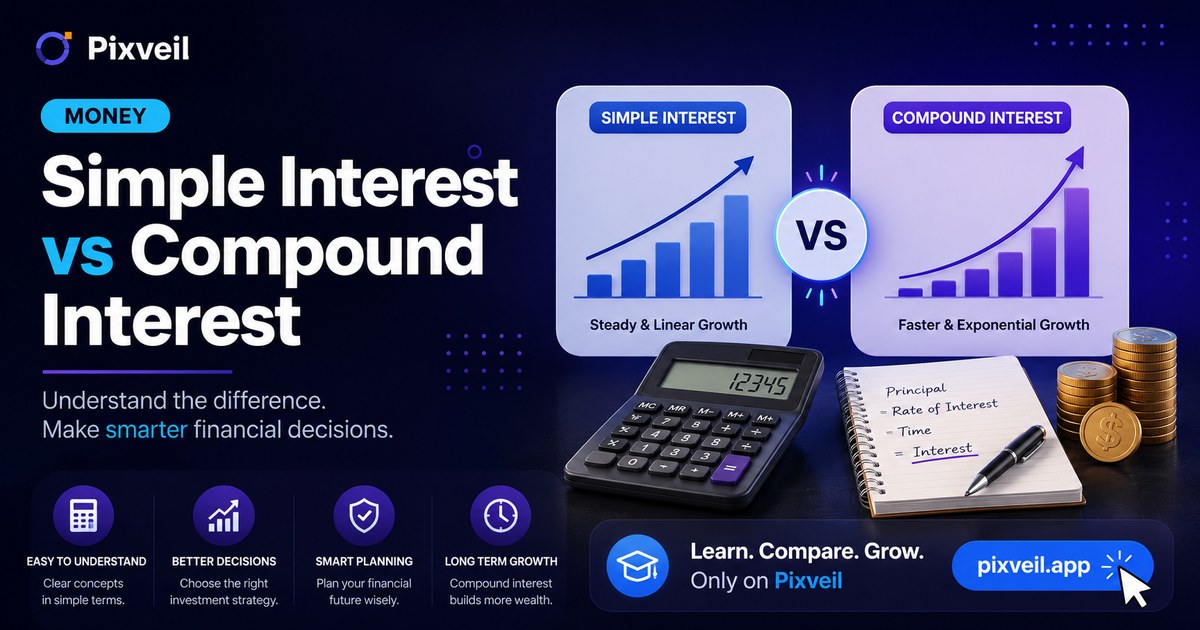
Two people each put $10,000 into an account paying 5% a year. Thirty years later, one has earned $15,000 in interest and the other has earned $33,219. Same deposit. Same rate. Same thirty years.
The only difference is which kind of interest the account paid. That gap — $18,219 on a $10,000 deposit — is what this article is about.
The difference in one sentence
Simple interest is paid only on the money you put in. Compound interest is paid on the money you put in plus all the interest it has already earned.
That's the whole idea. Everything else is arithmetic.
With simple interest, your $10,000 at 5% earns $500 every single year, forever. Year one: $500. Year twenty: still $500. The base never changes.
With compound interest, year one also earns $500 — but year two calculates 5% on $10,500, so it earns $525. Year three works on $11,025 and earns $551. Each year's interest becomes next year's principal, and the base keeps climbing.
Why the first year always looks identical. In year one there's no accumulated interest to compound yet, so both methods pay exactly the same. This is why compound interest feels like a scam that doesn't work when you first try it — the difference is invisible for the first couple of years, then becomes impossible to ignore.
The two formulas, without the jargon
You don't need these to use a calculator, but seeing them side by side makes the difference obvious.
Simple interest: I = P × r × t
Your principal, times the rate, times the number of years. Three numbers multiplied together. Nothing feeds back into anything.
Compound interest: A = P(1 + r/n)nt
Here n is how many times a year interest gets added. The important part is the exponent: nt sits above the line, not beside it. That's the mathematical signature of growth that feeds on itself.
If you'd rather not do it by hand, the Simple Interest Calculator and the Compound Interest Calculator both run in your browser — put the same numbers into each and watch the two answers separate.
What the difference actually costs
Here is $10,000 at 5% a year, calculated both ways. Interest earned, not total balance:
| Time | Simple interest | Compound interest | Difference |
|---|---|---|---|
| 1 year | $500 | $500 | $0 |
| 5 years | $2,500 | $2,763 | $263 |
| 10 years | $5,000 | $6,289 | $1,289 |
| 20 years | $10,000 | $16,533 | $6,533 |
| 30 years | $15,000 | $33,219 | $18,219 |
Look at what happens across the rows. After five years compounding is ahead by about a tenth. After thirty years it has earned more than twice as much. The gap doesn't grow steadily — it accelerates, because every dollar of extra interest starts earning its own interest.
This is also why the advice "start early" is not motivational fluff. It's a description of where the money in that bottom-right cell comes from.
Where you'll meet each one in real life
Neither type is more "official" than the other. Which one applies depends entirely on the product.
| Product | Usually uses | Who it favors |
|---|---|---|
| Savings accounts & CDs | Compound | You |
| Retirement and index-fund investing | Compound (via reinvested returns) | You |
| Credit cards | Compound, daily | The lender |
| Most US car loans | Simple, on the outstanding balance | Roughly neutral |
| Most US mortgages | Simple, on the outstanding balance | Roughly neutral |
| Short-term personal loans | Varies — read the paperwork | Depends |
The rule worth memorizing: you want compound interest on your savings and simple interest on your debts. Most people have it backwards without realizing, because the one debt that compounds hardest — the credit card — is also the easiest one to acquire.
How often it compounds matters too
"Compounds annually" and "compounds daily" are not the same deal. Here's $10,000 at 5% for ten years at four different frequencies:
| Compounding frequency | Interest earned | Final balance |
|---|---|---|
| Once a year | $6,288.95 | $16,288.95 |
| Every quarter | $6,436.19 | $16,436.19 |
| Every month | $6,470.09 | $16,470.09 |
| Every day | $6,486.65 | $16,486.65 |
Worth noticing: the jump from annual to quarterly is $147, but the jump from monthly to daily is only $17. Frequency has diminishing returns, and there's a mathematical ceiling it can never pass. So a bank advertising "compounded daily!" is offering you something real but small — the rate matters far more than the frequency.
APR and APY are not the same number. APR is the plain annual rate. APY has the compounding already baked in, which is why it's the higher figure. A credit card advertising 24.92% APR, compounded monthly, is actually charging an effective 27.97% a year. When you compare savings accounts, compare APY to APY.
When compound interest works against you
Everything above describes compounding as a gift. On the other side of the ledger it's the reason debt feels impossible to escape.
The average US credit card interest rate was 24.92% in August 2026, according to Forbes Advisor's weekly survey of over 250 cards. Here's what a $5,000 balance at that rate looks like under different repayment strategies:
| You pay | Time to clear | Total interest |
|---|---|---|
| Minimum only | 19 years, 8 months | $9,250 |
| $150 a month | 4 years, 10 months | $3,600 |
| $250 a month | 2 years, 3 months | $1,528 |
| $400 a month | 1 year, 3 months | $850 |
Paying $250 instead of the minimum saves $7,722 in interest and clears the debt seventeen years sooner. Same balance, same card, same rate — only the payment changed.
And there's a detail hidden in that first row that catches people out. At 24.92% APR, one month's interest on $5,000 is $103.83. A minimum payment set at a flat 2% of the balance would be $100 — less than the interest. A payment that small would mean the balance goes up every month no matter how faithfully you pay it. Real card issuers set the minimum as the interest plus about 1% of the principal, which is why the balance does eventually fall, just very slowly.
What today's rates mean for your savings
Compounding can only multiply the rate you're actually getting, and the spread between banks right now is unusually wide. As of August 2026, Bankrate puts the national average savings account yield at 0.63% APY, while the best high-yield savings accounts pay around 4% APY.
Same $10,000, same five years, same daily-compounding mechanics:
| Account | Interest after 5 years | Final balance |
|---|---|---|
| National average (0.63% APY) | $319.93 | $10,319.93 |
| High-yield savings (4.00% APY) | $2,209.97 | $12,209.97 |
That's a $1,890 difference for money sitting in the same kind of federally insured savings account. No extra risk, no lock-up, no clever strategy — just a different bank. Compounding amplifies whatever rate you give it, which cuts both ways: at 0.63% there's very little to amplify.
The ingredient that matters most is time
Rate gets all the attention. Time does more of the work.
Here's $200 a month at a 7% annual return, compounded monthly — roughly what a broad stock index has averaged over long periods, though no return is guaranteed:
| Years | You put in | You end with | Growth |
|---|---|---|---|
| 10 years | $24,000 | $34,617 | $10,617 |
| 20 years | $48,000 | $104,185 | $56,185 |
| 30 years | $72,000 | $243,994 | $171,994 |
| 40 years | $96,000 | $524,963 | $428,963 |
Read the last two rows again. Going from thirty years to forty adds $24,000 of your own money — and $280,968 to the final balance. The extra decade is worth almost twelve times what you actually contributed during it.
That's also the real cost of waiting. Starting at 35 instead of 25, at the same $200 a month, is a $139,809 decision.
The Rule of 72. To estimate how long money takes to double, divide 72 by the interest rate. At 7%, that's 72 ÷ 7 ≈ 10.3 years — the exact answer is 10.24, close enough to do in your head. This shortcut only works for compound interest. At 7% simple interest, doubling takes over 14 years.
Common mistakes and how to avoid them
- Comparing an APR to an APY. They measure different things. APY includes compounding; APR doesn't. Comparing them makes the APR product look better than it is.
- Assuming a loan compounds. Most US mortgages and car loans charge simple interest on the outstanding balance. Running them through a compound interest calculator will overstate what you'll pay — use the Loan Calculator or Mortgage Calculator instead.
- Chasing compounding frequency instead of the rate. Daily versus monthly compounding was worth $17 in the table above. Moving from a 0.63% to a 4% account was worth $1,890.
- Forgetting that inflation compounds too. A 4% return with 3% inflation is about a 1% real gain. The nominal number is not the whole story.
- Treating "start early" as advice for other people. The forty-year row exists because of the first year, not the last one.
The short version
- Simple interest pays on your original amount only. Compound interest pays on your original amount plus everything it has earned.
- They're identical in year one and dramatically different by year thirty — $15,000 versus $33,219 on a $10,000 deposit at 5%.
- You want compound interest on savings and simple interest on debt.
- Compare APY to APY. The rate matters more than the compounding frequency.
- Time is the strongest ingredient. The last decade of a forty-year run adds more than the first thirty years of contributions.
Run your own numbers through the Compound Interest Calculator — change one variable at a time and watch which one moves the answer most. It's usually not the one you expect.
A note on this article. The figures here are calculated, not estimated, using the standard interest formulas and the rates cited above. They're for illustration and general education only — this isn't financial advice, and it doesn't account for taxes, fees, or your own circumstances. Investment returns in particular are never guaranteed. For decisions about your own money, talk to a licensed financial professional.
Frequently asked questions
Simple interest is always calculated on your original amount. Compound interest is calculated on your original amount plus all the interest already added to it. Over one year they are identical. Over thirty years, $10,000 at 5% earns $15,000 in simple interest and $33,219 in compound interest — the same rate, on the same money, for the same time.
Only when you are the one earning it. If you are borrowing, compounding works in the lender's favor and against you, which is why credit card balances grow so quickly. The honest rule is: you want compound interest on your savings and simple interest on your debts.
A = P(1 + r/n)^(nt), where P is your starting amount, r is the annual rate as a decimal, n is how many times a year it compounds, and t is the number of years. A is what you end up with, so the interest earned is A minus P. The simple interest formula is much shorter: I = P × r × t.
It depends on the account. Most US savings accounts compound daily and pay monthly. Credit cards compound daily. Certificates of deposit vary. More frequent compounding earns more, but the effect is smaller than people expect — on $10,000 at 5% for ten years, daily compounding beats annual by about $198.
Compound. That is what APY means — annual percentage yield already includes the effect of compounding, which is why APY is slightly higher than the stated interest rate. When you compare savings accounts, compare APY to APY and you are comparing like with like.
Most US car loans and mortgages are simple-interest loans: interest is charged on the outstanding balance each month and does not get added back into the principal, as long as you pay on time. Miss payments and unpaid interest can be capitalized into the balance — at which point it starts behaving like compound interest.
Divide 72 by the interest rate. At 7% a year, 72 ÷ 7 ≈ 10.3 years to double — the precise answer is 10.24 years, so the shortcut is close enough for mental math. This is called the Rule of 72, and it only works for compound interest. Simple interest at 7% takes over 14 years to double.